Ukraine's Anti-Corruption Progress: New Achievements
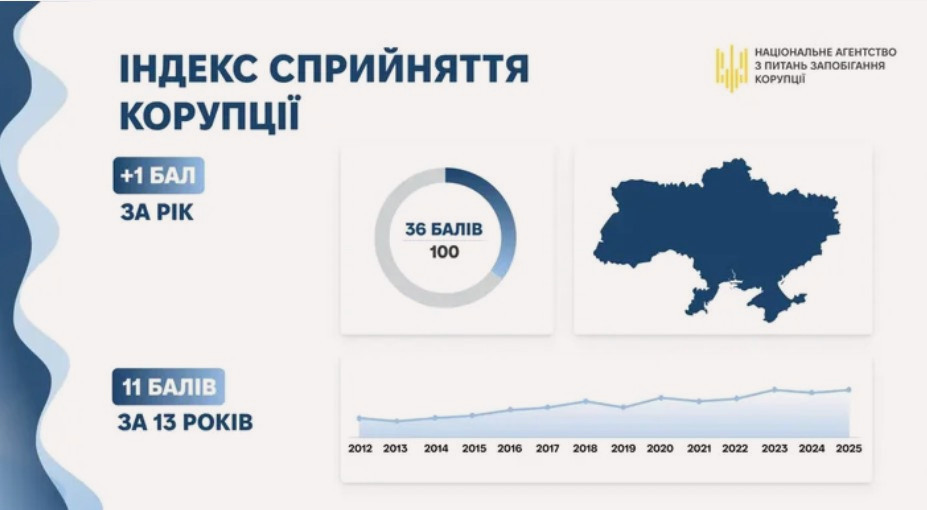
In 2025, Ukraine improved its scores in the Corruption Perception Index, gaining one point and ranking 104th among 182 countries. This information was reported by the National Agency for the Prevention of Corruption.
According to Transparency International Ukraine, the country now has 36 points in the CPI. This moderate progress has allowed Ukraine to rise in the ranking.
This assessment reflects a period during which Ukraine actively developed anti-corruption institutions, implemented measures of the State Anti-Corruption Program for 2023-2025, and drafted a new Anti-Corruption Strategy for the next five years.
Whistleblowers received their first rewards through court decisions, the lobbying institution was established, and the reform of managing seized assets took place.
This period was marked by numerous revelations of corruption crimes and an increase in the number of sentences for high-ranking officials.
Since 2013, Ukraine has progressed by 11 points, moving up from 144th place in the ranking (+40 positions).
Only about 20 countries have shown such growth. Meanwhile, the overall global trend remains unchanged - the vast majority of states worsen or at least do not improve their scores in the CPI.
As noted by the NAPC, Ukraine remains the only country in the world that improves anti-corruption indicators in the context of a major war and occupation.
Over four years of Russian aggression, compared to pre-war 2021, Ukraine added 4 points in the Index.
The CPI is calculated on a 100-point scale, where 0 indicates that corruption is the dominant form of social relations, and 100 indicates that corruption is virtually absent in the country.
Transparency International has been measuring the CPI since 1995, and the methodology was updated in 2012, making it appropriate to compare data only from that year onward.
The scores obtained by countries in the CPI reflect not the objective situation regarding corruption but rather how it is perceived by experts from reputable analytical organizations and businesses.
The CPI exclusively assesses the perception of corruption in the public sector and does not consider manifestations of petty corruption.
The Index is an aggregated indicator calculated based on 13 different sources (researches, reports, and surveys) from 12 institutions (for Ukraine in 2025 - based on 8 sources, such as the Bertelsmann Transformation Index, surveys from the World Economic Forum, and the “Variations of Democracy” index).
Different CPI sources focus on various issues, including the effectiveness of the punishment and prevention system, transparency and accountability in budget spending, the level of state intervention in the economy, protection of whistleblowers, and coverage of corruption cases in the media.
According to the head of the National Agency for the Prevention of Corruption Viktor Pavlushchik, the Anti-Corruption Strategy until 2030 will pay great attention to the development of digitalization, as it reduces corruption risks.