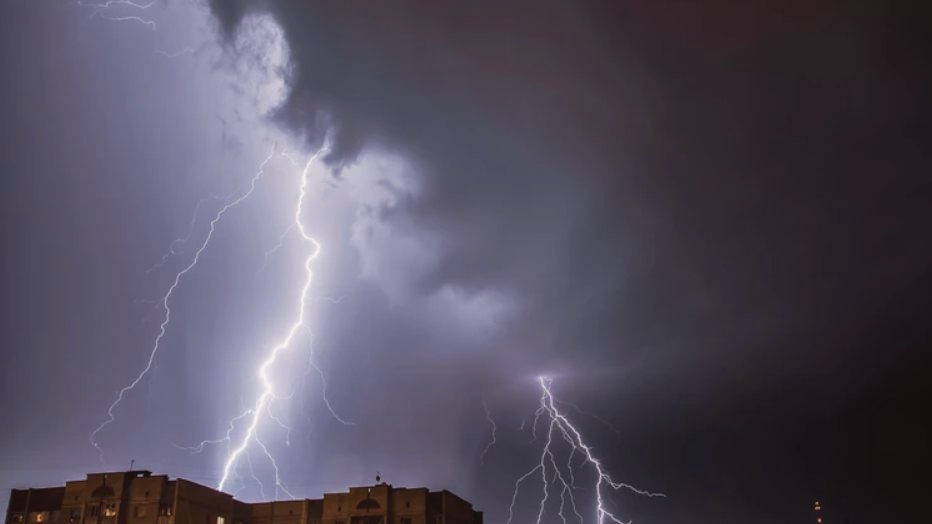
Lightning Threats: How to Stay Safe During a Storm
In the capital of Ukraine, Kyiv, a lightning strike hit one of the upper floors of a residential building in Obolon during a severe thunderstorm.
This incident was captured on video and shared across Telegram channels.
Alexander Kryvosheyn, head of the satellite research laboratory at the Ukrainian Hydrometeorological Institute, explained the reasons behind such occurrences and how to protect oneself from lightning strikes.
When can lightning strike a high-rise building?
Kryvosheyn noted that it is commonly believed that lightning always strikes the tallest point. However, this is not always the case.
"Lightning seeks the easiest path to discharge negative energy. Thus, it is not necessarily the highest object that it targets," the scientist explains.
This means that if there are buildings of different heights nearby, lightning may not hit the tallest one. A lot depends on various factors.
Firstly, lightning often "searches" for metal or concrete because they are excellent conductors of electricity. For instance, it can strike a wet concrete roof.
Water is also a strong conductor of electricity, which is why it's advised to stay away from open water bodies during a storm.
Another critical detail is that it depends on which electrical devices are operating in the building at that time. The more energy a device uses, the more attractive it becomes to lightning.
"As we can see in this video, lightning struck the higher floors. We need to investigate what devices were present there. It could have been an uninterruptible power supply, a charging station, a coffee maker, or an electric kettle – devices that consume a lot of energy," Kryvosheyn added.
How can one reduce the risk of a lightning strike?
High-rise buildings typically have lightning rods – metal spires that can absorb the strike when necessary. Lightning tends to hit these rods more often, as they are made of metal (an attractive object for lightning) and are often the tallest points.
However, lightning rods cannot guarantee 100% safety. People need to follow certain safety measures.
The best advice, according to Kryvosheyn, is to close windows during storms. A closed window can serve as a barrier between lightning and electrical devices.
"If the window is open, the 'connection' between the charge in the cloud and the object in the room is greater than when it is closed," he explains.
Secondly, all electrical devices should be turned off, particularly those that consume a lot of energy.
The third tip is to avoid standing near metal objects.
As for phone conversations, the scientist advises against speaking near windows and recommends following the 'two walls' rule.